
Sri Lanka Cultural Triangle Guide: Sigiriya, Dambulla, Kandy, Polonnaruwa & Anuradhapura
Planning a Sri Lanka heritage trip? Explore Sigiriya, Dambulla, Kandy, Polonnaruwa, and Anuradhapura with this practical Cultural Triangle guide.
If you want the part of Sri Lanka that feels the most layered, the most historic, and the most unmistakably rooted in the island’s past, this is it.
The Cultural Triangle is the name travelers usually use for the historic heart of Sri Lanka, built around some of the country’s most important ancient cities and sacred sites. Sri Lanka Tourism describes the island as having more than 3,000 years of history and highlights ancient cities such as Anuradhapura and Polonnaruwa as part of that heritage, while UNESCO lists Sigiriya, Dambulla, Kandy, Polonnaruwa, and Anuradhapura among Sri Lanka’s World Heritage sites.
For many first-time visitors, this region becomes the part of the trip that gives Sri Lanka real depth. Beaches may draw people in first, but the Cultural Triangle is where the island starts to feel older, richer, and more memorable. It is not just about ruins. It is about rock fortresses, cave temples, sacred cities, royal capitals, and the long story of Buddhism and kingship across the island.
What the Cultural Triangle really means
In practical travel terms, the Cultural Triangle usually refers to the cluster of major heritage destinations that most travelers combine in central and north-central Sri Lanka: Sigiriya, Dambulla, Kandy, Polonnaruwa, and Anuradhapura. It is not one single official UNESCO label, but it is a very useful way to think about this region when planning a route. UNESCO separately recognizes these destinations as distinct World Heritage sites, and Sri Lanka Tourism presents the island’s heritage in exactly this ancient-cities-and-sacred-sites way.
The good thing is that you do not need to visit every major site to appreciate the region. A shorter trip can still feel rich with just a few carefully chosen stops.
Why first-time visitors should include it
If it is your first time in Sri Lanka, the Cultural Triangle gives you something the beaches and hill country cannot: historical weight. You start to see how old the island’s civilization is, how central Buddhist pilgrimage remains, and how much engineering, planning, and artistry shaped these ancient kingdoms. Sri Lanka Tourism’s heritage pages emphasize precisely that long civilizational history, while UNESCO’s site descriptions make clear that these are not isolated monuments but parts of major political and religious capitals.
It also works well in a practical sense. This region pairs naturally with a first-timer route that later continues to Kandy, the hill country, safari, or the south coast. That route advice is a planning recommendation, but it is one of the reasons this cluster is so useful for a Sri Lanka itinerary.
Sigiriya: the most iconic stop
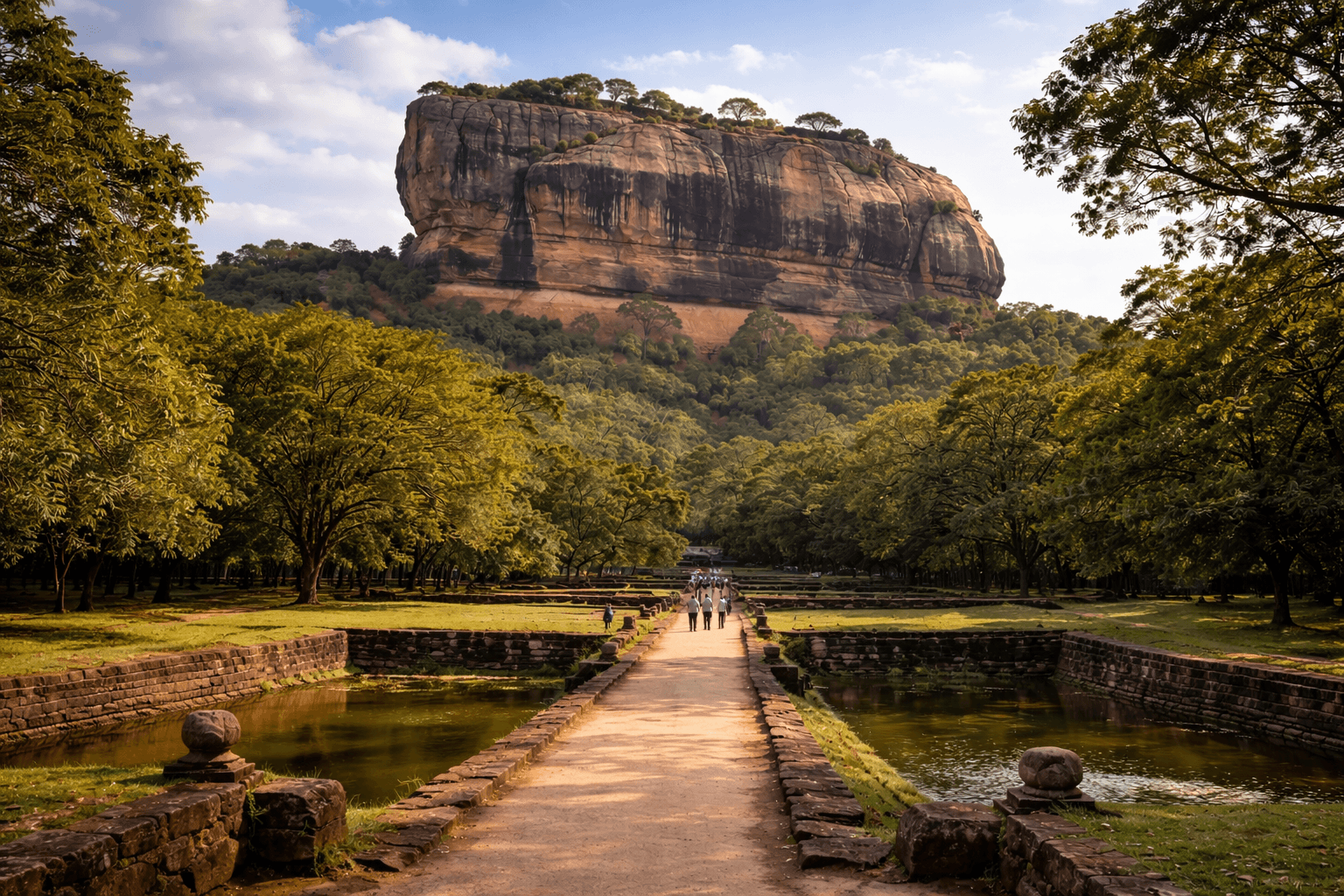
If there is one place in the Cultural Triangle that feels instantly unforgettable, it is Sigiriya. Sri Lanka Tourism says Sigiriya is famous for its palace ruins on top of a massive 200-meter-high rock, surrounded by gardens, reservoirs, and other structures, and notes that it was designated a World Heritage site in 1982.
What makes Sigiriya special is not just the rock itself. It is the full setting. Even before you climb, it already feels dramatic. Once you understand that this was a royal and defensive complex rising above the plains, the site starts to feel even more extraordinary. Sri Lanka Tourism also describes Sigiriya as one of Asia’s oldest landscaped gardens, which helps explain why it feels more sophisticated than a simple hilltop ruin.
For many travelers, Sigiriya is the emotional highlight of the Cultural Triangle. It is the place that photographs beautifully, but it also holds up in person.
Dambulla: the spiritual counterpoint
Dambulla is usually paired with Sigiriya, and that pairing makes perfect sense. If Sigiriya feels dramatic and outward-facing, Dambulla feels quieter and more inward. Sri Lanka Tourism says the complex dates to the first century BCE and consists of five caves built at the base of a 150-meter rock, filled with religious images, Buddha figures, and bodhisattvas. UNESCO goes even further, describing it as a sacred pilgrimage site for 22 centuries and the largest, best-preserved cave-temple complex in Sri Lanka, with 157 statues.
That is why Dambulla adds so much to the route. It gives the Cultural Triangle a living spiritual atmosphere, not just an archaeological one. The paintings, statues, and cave interiors make the heritage feel close rather than distant. It is one of those places that often surprises people because it looks more powerful in person than they expect from photos alone.
Kandy: the living sacred city
Kandy is often treated as the bridge between the Cultural Triangle and the hill country, but it is much more than a stopover. UNESCO describes it as the last capital of the Sinhala kings and notes that it is home to the Temple of the Tooth Relic, one of the most important pilgrimage sites in Buddhism.
That gives Kandy a different energy from the older ruin-based sites. It feels alive, ceremonial, and still central to Sri Lanka’s religious identity. The lake, the temple setting, and the city’s hill backdrop all make it one of the most atmospheric heritage stops on a first trip. It is not ancient in the same visual way as Anuradhapura or Polonnaruwa, but it is deeply important, and it helps the Cultural Triangle feel complete rather than purely archaeological.
Polonnaruwa: the medieval royal city
Polonnaruwa feels more orderly and more expansive than many first-time visitors expect. UNESCO says it became the second capital of Sri Lanka after the destruction of Anuradhapura in 993, and that it includes the monumental ruins of the garden-city created by Parakramabahu I in the 12th century. Sri Lanka Tourism also describes Polonnaruwa as one of the best-planned archaeological relic sites in the country.
That sense of planning is one of the reasons Polonnaruwa stands out. It does not feel like one isolated attraction. It feels like the remains of an organized capital, with the bones of a real royal city still visible. For travelers who enjoy ruins, carved stonework, and the feeling of walking through a place that once functioned at a grand scale, Polonnaruwa is usually one of the most rewarding stops in Sri Lanka.
Anuradhapura: the oldest and most sacred feeling
Anuradhapura has a different mood from Polonnaruwa. UNESCO says the sacred city was established around a cutting from the Buddha’s tree of enlightenment, brought there in the 3rd century BC, and that it flourished as a political and religious capital for 1,300 years before being abandoned after an invasion in 993.
That description tells you almost everything important about the feeling of Anuradhapura. This is not just an old city. It is a sacred landscape. The stupas, monasteries, and pilgrimage atmosphere give it a scale and gravity that feel different from the more compact drama of Sigiriya or the cleaner archaeological rhythm of Polonnaruwa. For travelers who want to feel the spiritual depth of Sri Lanka’s Buddhist heritage, Anuradhapura is often the place that stays with them the longest.
Which sites should you prioritize?
If you only have a short amount of time, you do not need to do all five.
For a 2- to 3-day Cultural Triangle trip, the strongest combination is usually Sigiriya + Dambulla + one of Polonnaruwa or Kandy. That gives you one iconic site, one sacred temple complex, and one broader heritage or city experience. This is a planning recommendation rather than an official itinerary, but it is usually the most realistic way to keep the trip enjoyable.
For 4 to 5 days, you can include Anuradhapura as well and let the region breathe more. That slower pace tends to work better because these are not places to rush through if you actually want to absorb them.
Where to stay
For many travelers, staying near Sigiriya, Dambulla, or Habarana works best for the core triangle section because it keeps you close to multiple major sites. Then Kandy works as its own overnight stop if you continue southward afterward. That is a route-planning recommendation, but it is usually the most practical structure for first-time visitors.
If your trip is very short, picking one good base and doing fewer day trips is often smarter than changing hotels constantly.
Is it worth visiting both Anuradhapura and Polonnaruwa?
Yes, but not always on the same short itinerary.
They are both UNESCO-listed ancient capitals, but they do not feel identical. UNESCO presents Anuradhapura as the older sacred political and religious capital, while Polonnaruwa is framed as the later medieval capital with monumental ruins and a more defined garden-city layout.
So if you have time, visiting both gives you a fuller sense of Sri Lanka’s historical development. If you do not have time, it is perfectly reasonable to choose just one. Travelers who want a more sacred and pilgrimage-oriented atmosphere often connect more with Anuradhapura. Travelers who prefer easier-to-read ruins and a more archaeological city layout often find Polonnaruwa more immediately accessible. That comparison is an interpretation based on the official site descriptions.
Final thoughts
The Cultural Triangle is one of the best reasons to visit Sri Lanka in the first place. It shows that the island is not only about beaches and scenery, but also about kingdoms, sacred cities, engineering, devotion, and a very long civilizational memory. Sri Lanka Tourism’s heritage material stresses that historical depth, and UNESCO’s listings confirm just how important these places are on a global level.
If you are planning your first trip, this is one of the most rewarding regions to include. You do not need to see every site to appreciate it. You just need to choose a route that gives you time to slow down and let the history sink in.
Comments
0 totalJoin the conversation and share your travel ideas.
No comments yet. Be the first one to start the discussion.